

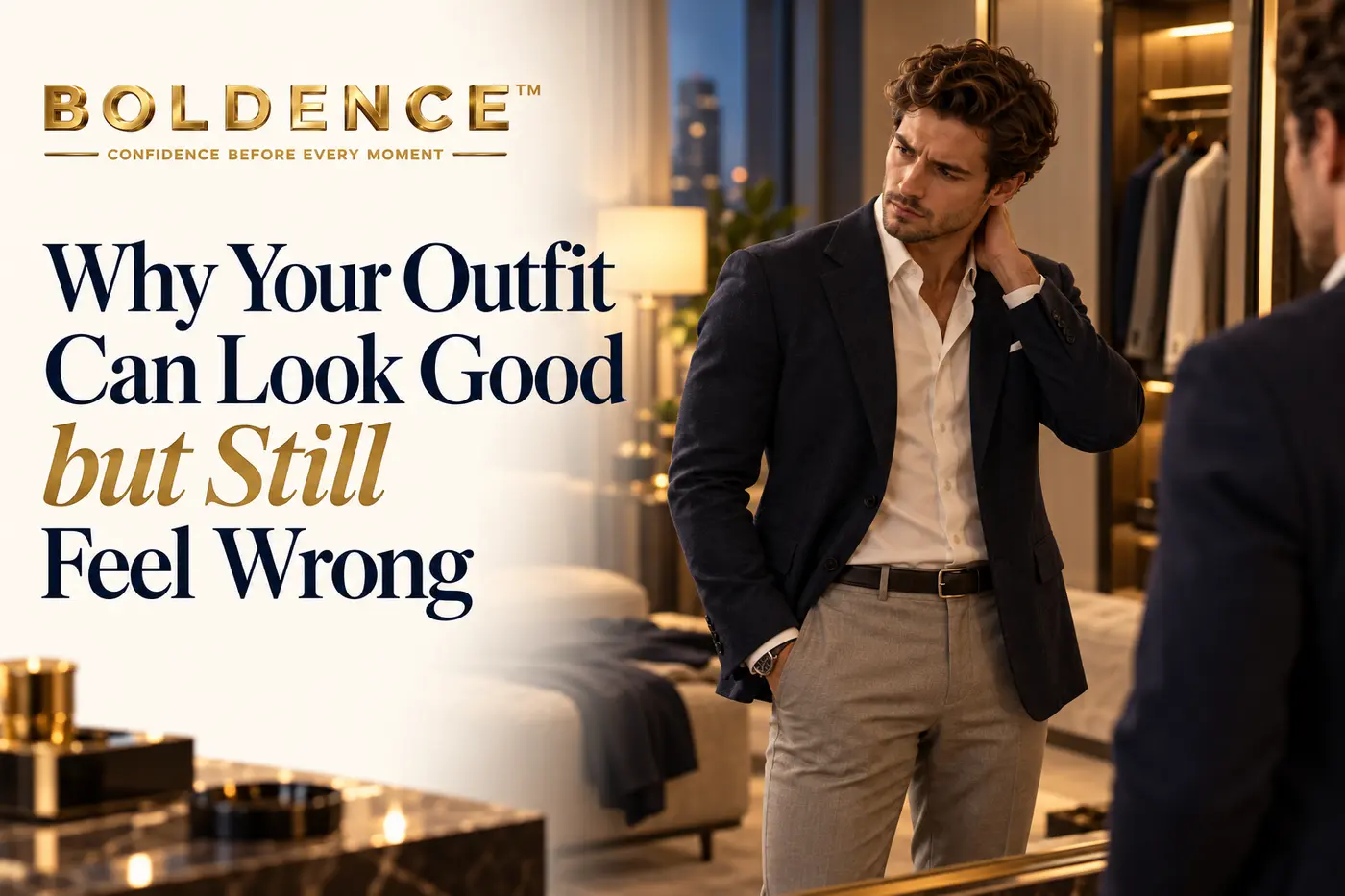
At home, the outfit worked. The colors were right, it fit well, and you liked what you saw in the mirror. Then you walked into the room, and something shifted. Nobody said anything, but you felt slightly out of step for the rest of the evening.
An outfit may look good to you and still feel unfamiliar once you arrive. The room can change how you interpret it, but so can ordinary nerves, heightened self-awareness, or trying a different way of dressing. Feeling unsettled is information to consider, not proof that you made a bad choice. This article explores why that difference can happen.
Why Can an Outfit Look Good but Feel Wrong?
Looking good is a judgment about the outfit. Feeling right is a judgment about the match between the outfit and the situation. An outfit can succeed on the first and still miss on the second when its formality, tone, practicality, or personality doesn’t line up with the setting, the people, or your role in it.
In other words, “Does this look good?” and “Is this appropriate attire for where I’m going?” are two separate questions. Most of us only ask the first one in front of the mirror.
Five Possible Sources of the “Something’s Off” Feeling
1. A formality mismatch
One possibility is a difference in formality. You’re in a structured blazer at a backyard barbecue, or in a casual knit at a dinner where everyone else is in cocktail attire. Sometimes feeling overdressed or underdressed comes from noticing a difference between your look and the room. That does not automatically mean you need to change.
Even small differences can register. Polished leather shoes at a casual party may be fine. A full suit at the same party will probably feel heavy.
2. A tone mismatch
Formality isn’t the only thing an outfit communicates. Clothes also carry a mood. Bright prints and playful accessories feel celebratory. Dark, structured pieces feel serious. A tone mismatch happens when the mood of your outfit doesn’t line up with the mood of the event.
Imagine a lively, colorful outfit at a quiet, high-stakes business meeting, or a very buttoned-up look at a relaxed birthday dinner with friends. Both outfits might be technically appropriate in formality and still feel slightly wrong in spirit.
3. A function mismatch
Some outfits fail on practicality rather than appearance. Heels that sink into a lawn. A jacket that’s too warm for a crowded room. A skirt that rides up every time you sit on a low couch. Trousers too tight to sit through a three-hour ceremony comfortably.
When an outfit doesn’t support what you’re actually doing, you notice it constantly. That attention pulls you away from the people and the conversation, which is often what makes the whole experience feel off.
4. A role mismatch
Your role at an event changes what your clothes need to do. If you’re presenting, you need to look clean and move comfortably in front of a room. If you’re interviewing, you want to look prepared and professional. If you’re a guest at someone else’s celebration, you want to look festive without pulling focus from the host or the couple.
An outfit can look great and still clash with your role. A dramatic statement look might be perfect for your own birthday party and feel too much as a guest at someone else’s.
5. An identity mismatch
Sometimes the outfit fits the event perfectly and still feels wrong because it doesn’t feel like you. You borrowed someone else’s idea of what “appropriate” looks like, and now you feel like you’re wearing a costume. This one is easy to overlook because, on paper, you did everything right.
Appropriate attire shouldn’t mean erasing your personal style. The best fit for an occasion usually sits where the expectations of the event and your own way of dressing overlap.
Why the Mirror Can Mislead You
Part of the problem is how we check outfits. At home, you’re seeing the look:
- In isolation, without the room, the other guests, or the venue around it
- In familiar lighting, which may be very different from a restaurant, office, or outdoor venue
- Standing still, rather than sitting, walking, or reaching
- For a few seconds, rather than for the full length of the event
A mirror is good at telling you whether pieces work together. It’s not very good at telling you whether the whole look fits the setting you’re about to walk into. That’s a context question, and it needs context to answer.
When an Outfit Feels Off: Check the Evidence, Not Just the Feeling
Before changing anything, separate a practical problem from normal uncertainty. Is there a clear dress code or comfort issue, or do you simply feel more visible than usual? If your outfit works for the setting and feels physically comfortable, you may not need to change it at all.
- Notice the feeling without assuming it proves there is a problem.
- Check concrete evidence: event requirements, physical comfort, weather, and mobility.
- Consider whether nerves or an unfamiliar style may be affecting how you feel.
- Change something only if it addresses a specific practical issue or your own preference.
- If the outfit meets your needs, it is reasonable to keep wearing it.
- For an actual before-the-event outfit check, read Blog 8: How to Know If Your Outfit Actually Fits the Occasion.
BOLDENCE organizes guidance around the Moment you choose, rather than imposing a universal clothing rule. You can make the decision yourself; BOLDENCE offers another context-aware perspective when you want one.
A Quick Example of the Mismatch in Action
Picture a sleek, all-black outfit: tailored trousers, a fitted top, and pointed leather shoes. In the mirror, it looks sharp and modern. Now place it in three settings.
At an evening gallery opening, it may feel in step with the occasion. The formality, tone, and setting all line up. At a client meeting at a conservative firm, it probably still works, though the shoes might feel slightly fashion-forward. At a Saturday afternoon picnic, it might feel less practical, especially if the ground is soft and the weather is hot. The level of formality is too high, the tone is too serious for a relaxed day, the shoes don’t work on grass, and dark fabric in the sun is uncomfortable.
Same outfit, different practical and social cues. None of these cues can tell you how you must feel; they simply offer context for your own decision.
What to Do If an Outfit Feels Wrong Once You’ve Arrived
You can’t always go home and change, but you can usually adjust:
- Overdressed? Remove a jacket or tie, take off a statement accessory, or roll your sleeves.
- Underdressed? Add a layer if you brought one, tuck in a shirt, or put on a piece of jewelry.
- Uncomfortable? Find a moment to adjust what’s bothering you, then let it go.
Then shift your attention outward. Most people notice what others are wearing for a moment and then move on to the conversation. You can do the same.
Common Questions About Feeling Wrong in an Outfit
Is the “off” feeling usually in my head?
Not necessarily. An outfit can feel unfamiliar because you are nervous, trying a different style, or anticipating an important event—not because anything is wrong with it. Check the actual setting and practical fit first. If those are sound, you may decide to keep the look and give yourself time to settle into it.
Do other people notice?
Usually far less than you do. Most people are focused on their own experience. Still, feeling aligned with the setting makes it easier for you to relax, which people do notice.
How can I tell if anything actually needs changing?
Look for something specific, such as physical discomfort or an explicit event requirement. Feeling self-conscious might also be ordinary nerves, not a problem with your clothing. There is no obligation to fix every uneasy feeling.
Can an outfit be appropriate and still be bold?
Yes. A bold outfit that matches the occasion’s formality, tone, and practical demands can feel completely right. Boldness and appropriateness are not opposites; the host’s guidance and your practical needs are better signals than whether a style attracts attention.
Look Good and Feel Right
Looking good and feeling right aren’t the same thing, but they don’t have to compete. When you start with the occasion, gather real context, and then build an outfit that fits both the setting and your own style, you get both.
If you’d like help seeing your outfit through the lens of a specific event, explore the moments BOLDENCE is built around and see how BOLDENCE’s context-aware guidance works. BOLDENCE is currently in pre-launch. Join the BOLDENCE waitlist for early access.