
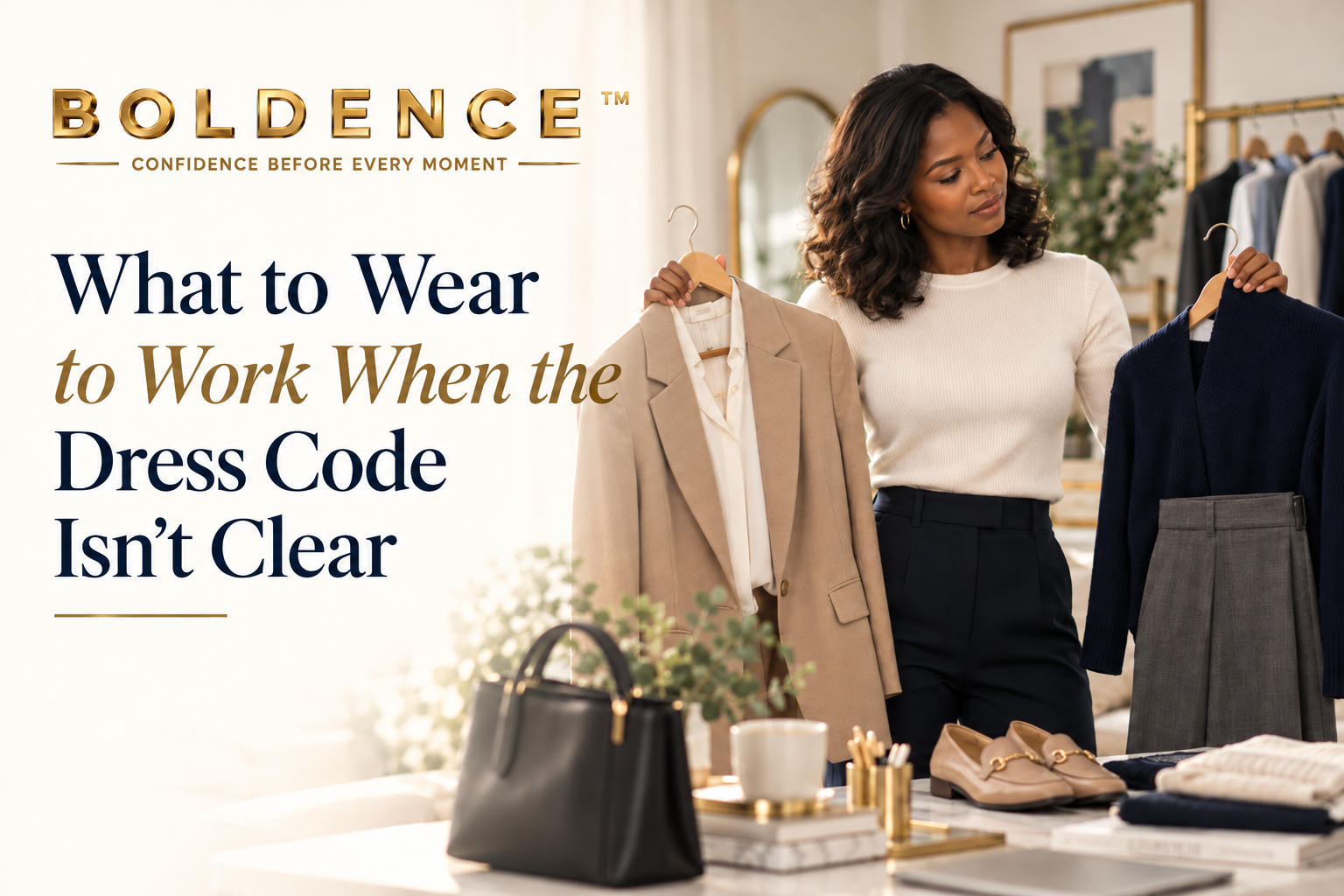
The employee handbook says “dress appropriately for your role.” Your manager says “we’re pretty relaxed.” The one coworker you met during the interview was wearing a quarter-zip, and the VP in the lobby had on a tailored suit. None of that tells you what to put on Monday morning.
A vague work dress code is one of the most common sources of low-grade outfit stress. It shows up when you start a new job, move to a different team, return to the office after working remotely, or join a company that never wrote a dress code down in the first place. The fix isn’t guessing. It’s collecting a few clues, picking a sensible starting point, and building outfits that can adjust once you understand the room.
What Does “Dress Code” Usually Mean in a U.S. Workplace?
Most American workplaces fall somewhere on a spectrum, even when nobody names the category out loud:
- Business formal: Full suits, dress shoes, conservative colors. Common in some law, finance, and government settings, or for high-stakes meetings.
- Business professional: Tailored pieces like blazers, dress trousers, skirts, button-down shirts, and polished shoes. A suit isn’t always required, but the overall look is structured.
- Business casual: Collared shirts, blouses, knits, chinos, dress pants, and simpler shoes. Jackets are optional.
- Smart casual: Clean, well-fitting everyday clothes with some polish, like dark jeans, a crisp shirt or sweater, and minimal sneakers or loafers.
- Casual: Comfortable everyday clothing, often with an unspoken expectation that it still looks neat.
When a company says “no dress code,” it usually means somewhere between business casual and casual, not “anything goes.” Reading where your workplace sits on that spectrum is the first job.
How to Figure Out an Unclear Dress Code at Work
You likely have more information than you think. Here are the most useful places to look.
Written guidance, even if it’s thin
Check the offer letter, onboarding emails, handbook, or intranet. Even a single line like “business casual, jeans on Fridays” gives you a baseline. If something is written down, treat it as the strongest context you have.
What you saw during the interview
Think about what you saw during interviews, but treat any one person’s outfit as a clue rather than a dress-code rule. Look for patterns across employees in similar roles, consider the company’s public photos, and ask the recruiter or manager if the expectations remain unclear.
Company photos and social profiles
The company website, careers page, and LinkedIn photos of employees often show what people wear day to day. Team photos from offsites and office events can be especially telling.
Your industry and your schedule
A product designer at a startup and an account manager at an insurance company may both be “business casual,” but they’ll interpret it differently. Your calendar matters too. If you’re client-facing, presenting, or meeting senior leaders, expect the dress code to lean more formal on those days.
Ask
It’s completely normal to ask your manager, recruiter, or HR contact, “What do people usually wear day to day?” Asking shows you care about fitting in. It isn’t a sign that you’re unprepared.
What to Wear on Your First Day at a New Job
If you’re still unsure after all of that, choose a flexible option near the polished end of the likely dress-code range, then adjust once you have better information.
For a business casual office, that might be tailored trousers or a skirt, a crisp shirt or fine-gauge knit, a light jacket you can remove, and clean leather shoes. For a casual office, try dark jeans without distressing, a neat top or button-down, and shoes that look cared for.
After a day or two, you’ll have real information. You can relax your choices to match the norm, or keep a slightly sharper edge if that feels more like you.
The Adjustable Outfit: Your Best Tool When You Can’t Tell
When the workplace dress code is unclear, an outfit you can dial up or down is more useful than one perfect guess. A few ways to build that flexibility:
- A removable layer. A blazer, structured cardigan, or overshirt adds formality when you wear it and disappears onto the back of your chair when you don’t need it.
- Neutral base pieces. Navy, gray, black, camel, and white pair easily, so swapping one piece doesn’t throw off the rest of the outfit.
- Shoes in the middle. Loafers, simple flats, low boots, or clean leather sneakers sit in a zone that works across several dress codes.
- Accessories that suit your style. Minimal accessories can be an easy, flexible option; expressive or multiple accessories can work too when they fit the workplace context.
This approach takes pressure off the guess. If you walk in slightly overdressed, you remove the jacket. If you’re a little underdressed, a layer you brought along closes the gap.
Business Casual vs. Business Professional: Where People Get Stuck
These two categories cause the most confusion because they overlap. A simple way to tell them apart:
- Structure: Business professionals lean on tailored, structured pieces. Business casual allows softer fabrics and knits.
- Jackets: Expected or close to it in business professional. Optional in business casual.
- Shoes: Polished dress shoes, heels, or flats for professionals. Loafers, clean flats, and sometimes minimal sneakers for casual.
- Denim: Rare in business professional. Sometimes acceptable in business casual, often on specific days.
If your office sits somewhere in between, a tailored pant or skirt with a knit top and a blazer on standby covers both.
When the Dress Code Shifts During the Week
Even workplaces with a relaxed baseline have days that call for more polish. Client meetings, presentations to leadership, performance reviews, and company events can all shift expectations.
Look at your calendar the night before. If you have an important meeting, the Business Meeting guidance from BOLDENCE is a useful way to think through formality, footwear, and how the full look comes together. If you’re standing in front of a group, the Presentation Moment focuses on movement, fit, and details that stay comfortable while you speak.
What About Hybrid Work and Video Calls?
On video, the top half of your outfit carries most of the weight. Solid colors and simple necklines tend to read well on camera, and a collar or structured layer can make a casual top look more put-together. If you’re hybrid, it helps to keep office attire and at-home clothes in the same general range so you’re not rebuilding your look every time you switch.
Quick Check: Does Your Outfit Fit Your Workplace?
Before you leave, look at your full outfit and ask:
- Does it look like it belongs in the same range as what my coworkers wear?
- Is anything wrinkled, stained, faded, or worn at the edges?
- Do my shoes match the formality of the rest of the outfit?
- Can I sit, stand, walk, and reach comfortably in it all day?
- If my manager pulled me into a last-minute meeting, would I feel fine?
If most of those are a yes, you’re in good shape.
Common Questions About Unclear Work Dress Codes
Is it better to overdress or underdress at work?
Slightly overdressed is usually easier to fix. You can remove a layer or relax your choices the next day. Being noticeably underdressed is harder to correct at the moment.
Can I wear jeans if the dress code doesn’t mention them?
Watch what others do first. If jeans are common, dark, clean, well-fitting denim is usually the safest version. If you haven’t seen anyone in jeans, wait before trying them.
Are sneakers acceptable at work?
In many smart casual and casual offices, yes, especially minimal leather or clean canvas styles. In business professional settings, they’re less likely to fit.
What if I want my work clothes to still feel like me?
You can. Professional attire doesn’t have to erase your personality. Color, texture, and a signature accessory let your style show up within the expected range.
Start With What You Know, Then Adjust
An unclear work dress code is less about finding one right answer and more about narrowing the range. Use the written guidance you have, look at what people around you wear, pay attention to your calendar, and build outfits that can move up or down in formality.
If you would like another perspective on a specific look, select the Professional Moment, share a clear photo of your complete outfit, and explore context-aware guidance on fit, color coordination, footwear, and how the pieces work together. You remain the decision-maker. BOLDENCE is currently in pre-launch. Join the BOLDENCE waitlist for early access.