
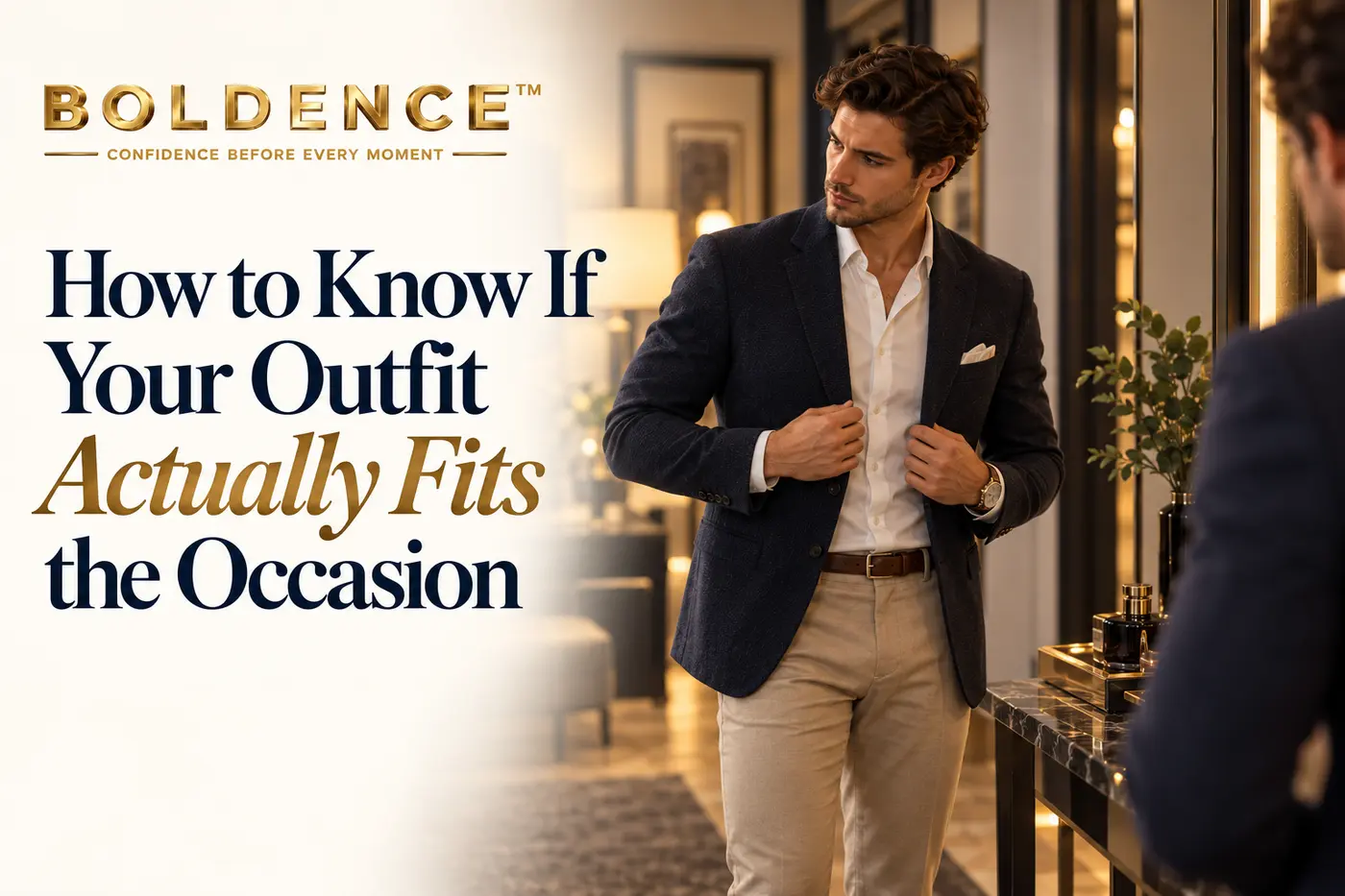
You’ve picked an outfit. You like it. You’ve probably worn it before and felt good in it. But now it’s the night before an important event, and a small question keeps coming back: is this right for this?
That question, “Does my outfit fit the occasion?”, is different from “Does this look good?” A great outfit can still be wrong for the setting, and a simple one can be exactly right. The difference comes down to context. Once you know which parts of the context to check, you can answer the question with much more confidence and much less guessing.
What Does It Mean for an Outfit to Fit the Occasion?
An outfit fits the occasion when it matches the event’s level of formality, works for the setting and its practical demands, suits the time of day, supports the role you’ll be playing, and still feels like you. When all five line up, the outfit tends to disappear into the background, and you can focus on the moment itself.
When one of these factors is off, you may notice a practical mismatch—for example, shoes that do not suit the terrain or a layer that does not meet the event’s needs. Feeling uncertain by itself does not necessarily mean the outfit is wrong.
The Five-Point Occasion Check
The simplest way to dress for the occasion is to check five things, in this order.
1. Formality
Start here, because it rules out the most options. Where does the event sit on the spectrum from casual to formal? If there’s a stated dress code, it’s your strongest signal. If there isn’t, look at the invitation’s wording, the venue, and what the host or organizer has said.
One way to compare formality is to consider casual, smart casual, business casual, cocktail, and formal as rough reference points, not fixed steps. Aim for the range suggested by the event and your own needs. If information is limited, a flexible option can help without automatically dressing more formally.
2. Setting and practical demands
Where will you be, and what will you be doing? A garden, conference center, restaurant, office, or rooftop each puts different demands on your clothes. Consider:
- Surfaces: grass, gravel, stairs, or polished floors
- Movement: standing for hours, walking between rooms, presenting, dancing
- Climate: outdoor heat, cold session rooms, or a temperature drop after dark
An occasion-appropriate outfit has to work in practice, not just in the mirror.
3. Time of day
The same event type can shift with the clock. Daytime events tend to welcome lighter colors and more relaxed fabrics. Evening events often lean darker, richer, and slightly dressier. A 2 p.m. wedding and an 8 p.m. wedding with the same dress code can call for noticeably different choices.
4. Your role
Are you the guest, the host, the candidate, the presenter, or the person meeting a new client? Your role changes what the outfit has to do. A presenter needs clothes that move well and look clean from across a room. A job candidate needs a look that reads as prepared and professional. A guest at a friend’s party mostly needs to fit in comfortably.
5. Comfort and personal style
Finally, does it feel like you, and can you wear it for the entire event without thinking about it? An outfit that matches every rule but makes you feel like you’re in a costume can still be the wrong choice. The right one fits the occasion and lets you act naturally.
How to Read the Dress Code When Nobody States One
Most occasions don’t come with a written dress code. In those cases, look for these clues:
- The invitation itself: printed cardstock or a casual text message, an evening start time or a midday one
- The venue: search for photos online, including photos of past events
- The organizer or host: how they usually dress and how they’ve described the event
- The people attending: coworkers, clients, family, close friends, or strangers
- The purpose: a celebration, a professional milestone, or a relaxed get-together
If you’re still unsure, ask. Hosts, recruiters, and event organizers usually prefer a quick question to a guest who feels uncomfortable.
Check the Full Look, Not Just the Main Piece
If you’ve ever wondered how to look put together for a specific event, this is often where the answer is. A common mistake is judging an outfit by its biggest item, like the dress, the suit, or the jacket, and forgetting the rest. In practice, shoes, layers, bags, and accessories often decide whether a look fits the occasion. A cocktail dress with chunky sneakers sends a different signal than the same dress with simple heels or polished flats.
When you look at the full outfit, it helps to think in a few categories:
- Fit and silhouette: Do the proportions, length, and overall shape work together?
- Color harmony: Do clothing, shoes, and accessories form a coherent palette?
- Polish and finish: Are fabrics pressed, shoes clean, and details in good condition?
- Styling balance: Are layers, textures, and accessories supporting each other instead of competing?
- Alignment with the occasion: Does the complete look match the event’s general level of formality?
These are the same visible signals BOLDENCE uses to structure its guidance. You can read more about them on the How It Works page.
One Outfit, Three Occasions
To see how context changes things, picture a navy blazer, white shirt, dark jeans, and brown leather loafers.
- At a startup job interview: Likely a good fit. It’s polished without being stiff, which suits a smart casual workplace.
- At a casual weekend brunch: Possibly a bit sharp. Dropping the blazer or swapping to a knit would bring it in line.
- At a formal evening wedding: Too casual. The jeans and loafers shift it well below the expected formality.
Nothing about the outfit changed. Only the occasion did. That’s the core of an outfit check: you’re judging the match, not the clothes in isolation.
Red Flags That an Outfit May Not Fit the Occasion
- You keep picturing yourself being the only person dressed this way
- Your shoes don’t work for the surface, distance, or formality
- You’d need to explain the outfit choice to someone
- The outfit depends on weather or a setting you haven’t confirmed
- You’re comfortable for the first ten minutes but won’t be for three hours
Any one of these is worth a second look. Often a single swap, like changing shoes, adding or removing a layer, or simplifying an accessory, fixes it.
When Outfit Feedback Is Most Useful
Sometimes your own judgment is enough. Other times, a second perspective helps. Outfit feedback tends to be most useful when the occasion feels unfamiliar, the dress code is unclear, or you’re torn between a few options and want a more structured way to compare them.
That’s the gap BOLDENCE is built to fill. You choose the Moment you’re preparing for, add a clear, full-body photo of the look you plan to wear, and review guidance on what’s working and where a focused refinement might help. It’s a way to look put together for the specific moment ahead, while your own knowledge of the event still leads to the decision.
Common Questions About Dressing for the Occasion
What if I’m still unsure after checking everything?
Choose the slightly more polished option that’s easy to adjust, such as a look with a removable layer or shoes that work across settings.
Is it okay to be more dressed up than everyone else?
Slightly, yes. Being far more formal than the room can feel uncomfortable, but a small step above usually reads as thoughtful.
How far in advance should I check my outfit?
For important events, try the full look a few days ahead. That leaves time to fix a hem, polish shoes, or find a better layer.
What if the outfit fits the occasion but I don’t love it?
If a practical change would help, consider adjusting a piece that feels least like you, such as the shoes, a layer, or an accessory, while keeping the parts that match the formality. An outfit that fits the event and feels like your own is worth a small swap.
Judge the Match, Not Just the Outfit
The question isn’t whether an outfit is good. It’s whether it’s good for the occasion in front of you. Check formality, setting, timing, your role, and your own comfort, then look at the complete look from head to toe. Most of the time, you’ll either confirm your choice or find the one small change that makes it right.
To see how BOLDENCE organizes guidance around specific events, browse the Moments you can prepare for, from interviews and meetings to weddings and date nights. BOLDENCE is currently in pre-launch. Join the BOLDENCE waitlist for early access.