

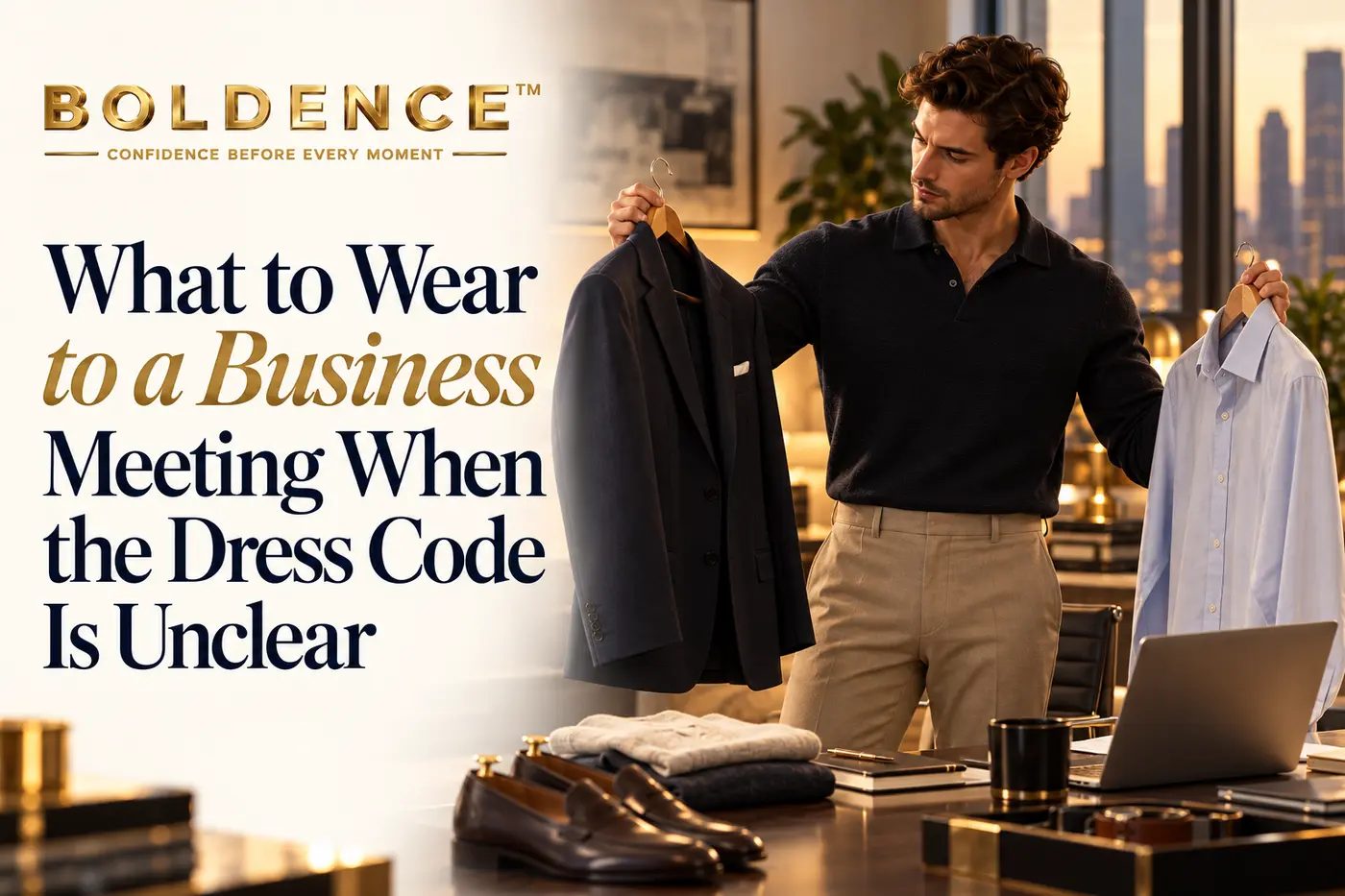
You have a meeting on Thursday at a client’s headquarters. You’ve never been to their office. You don’t know if they’re a suits-every-day company or a hoodies-and-sneakers company, and the calendar invite doesn’t say. Your own office is somewhere in between, which doesn’t help.
An unclear business meeting dress code is a common source of quiet stress, especially when the meeting matters. The good news is that you don’t need to guess blindly. The meeting type, the people involved, and whose space you’re meeting in all point toward a sensible choice. Add a flexible outfit that can shift slightly up or down, and you’ll be ready for whatever room you walk into.
What Should You Wear When the Business Meeting Dress Code Is Unclear?
When a meeting’s dress code is unclear, start with the host or client’s known norms, the industry, the purpose of the meeting, and any written guidance. Choose something comfortable within that likely range. An adjustable layer can be useful if it suits your style, but there is no need to dress for the most senior person in the room.
That approach shows respect for the meeting without risking looking dramatically overdressed. It’s much easier to take a jacket off than to wish you had one.
Start With a Simple Question: Whose Dress Code Is It?
Many people default to their own office norms. That works for internal meetings, but it’s less reliable when you’re meeting someone else.
- Meeting at your office: Your company’s norms are the baseline, with a little extra polish if visitors are coming in.
- Meeting at their office: Their norms matter more. Lean toward what their team likely wears, then add a step of polish because you’re the visitor.
- Meeting on neutral ground: At a restaurant, coffee shop, or conference, consider both organizations and the venue itself.
To learn another company’s norms, check their website, team page, LinkedIn photos, and any recent event or office photos. If a colleague has met with them before, ask what they wore and what they saw.
Business Meeting Attire by Meeting Type
Internal team meeting
For routine internal meetings, your normal work outfit is usually fine. If the meeting is more formal than usual, like a quarterly review or a planning session with other departments, add a layer or choose sharper shoes.
Meeting with senior leadership
For a meeting with senior leaders, the useful cues are the organization’s actual culture, the meeting format, and the audience’s expectations—not job titles alone. Choose an outfit suited to those cues and your role in the discussion; a tailored layer is one possibility, not a requirement.
First meeting with a new client
First impressions carry extra weight here. A client meeting outfit should look prepared and considered. If the client’s culture is unknown, business casual with a structured jacket is a safe middle. If you know they’re a formal organization, such as a law firm, bank, or government office, step up to a business professional or a suit.
Pitch or sales meeting
When you’re asking for business, presentation matters more. Many people dress slightly more formally than the client’s day-to-day norm to signal that they take the opportunity seriously. Just avoid going so formal that you feel out of step with the room.
Lunch or coffee meeting
These often lean a bit more relaxed, but you’re still representing your work. A business casual meeting outfit, like trousers or dark jeans (if your industry allows), a crisp shirt or fine knit, and a light jacket, usually fits well. Consider the venue, too. A downtown steakhouse and a neighborhood coffee shop call for different choices.
Virtual meeting
Virtual meeting attire matters mostly from the shoulders up. Solid colors and simple necklines look cleaner on camera than busy patterns. A collared shirt, structured knit, or blazer adds polish for client calls and leadership meetings. Check your lighting and background along with your outfit.
Use Industry Clues
Industry is one of the strongest signals for an unclear dress code:
- Finance, law, consulting, and government: Often more formal. When in doubt, wear a suit or business professional attire.
- Tech and startups: Often smart casual, though meetings with investors or enterprise clients may be dressier.
- Creative industries: More room for personal style, but polish and fit still matter.
- Healthcare, manufacturing, and field-based work: Practical requirements may apply, especially for site visits. Ask whether specific footwear or clothing is expected for safety.
How to Build a Flexible Business Meeting Outfit
When you can’t pin down the expectations, choose pieces that move easily between business casual and business professional:
- A structured layer: A blazer or tailored jacket in navy, charcoal, black, or camel
- A clean base: Tailored trousers, a skirt, or a simple dress in a neutral color
- A versatile top: A button-down, silk blouse, or fine-gauge knit
- Shoes in the middle: Leather loafers, polished flats, low heels, or dress shoes that aren’t overly formal
- Accessories suited to your style: A watch, belt, understated jewelry, or expressive pieces that suit the meeting context
With the jacket on, this outfit reads as professional. With it off, it’s comfortably business casual. You can adjust within seconds of seeing the room.
What Colors and Patterns Work Best for a Business Meeting?
When the dress code is unclear, color is an easy place to reduce risk. Navy, charcoal, gray, black, white, light blue, and earth tones like camel and olive work across nearly every industry and level of formality. They also pair easily, which helps your full outfit look cohesive.
You don’t have to avoid color entirely. A deep burgundy knit, a soft blue shirt, or a patterned tie can add personality. One easy option is to keep larger pieces neutral and use a smaller color accent, but a coordinated colorful look can suit the meeting just as well. For video meetings, solids generally look cleaner on camera than tight stripes or small checks, which can flicker on screen.
If the meeting is high-stakes and you’re unsure, a coordinated neutral palette lets the conversation take center stage.
Details That Matter Once You’re at the Table
Business meetings involve a lot of sitting, which changes what people see. A few details deserve attention:
- The seated view: Check how your outfit looks when you sit. Jackets can bunch, shirts can gape, and skirts or trousers can ride up.
- Sleeves and cuffs: Your hands will be on the table, so sleeves and cuffs are more visible than usual.
- The top half: Across a conference table, your top half carries most of the impression. Make sure collars, necklines, and layers look neat.
- Comfort over time: Choose pieces that stay comfortable while sitting, standing, moving, and talking for the full length of the meeting.
These small details support a professional presence without drawing attention to themselves.
Common Questions About Business Meeting Dress Codes
Do I need to wear a tie to a business meeting?
Not always. In many U.S. workplaces, ties are reserved for formal industries or important occasions. If you’re unsure, wear a jacket and bring a tie in your bag. Putting one on is easy; you can’t produce one out of nowhere.
Can I wear jeans to a business meeting?
Only if you know the setting is casual, such as an internal meeting at a company where jeans are the norm. For client meetings or meetings with leadership, trousers are the safer choice.
Is it okay to ask what to wear?
Yes. Asking the organizer or your contact, “What’s the usual dress for your team?” is professional and practical.
What if I’m overdressed when I arrive?
Remove the jacket, loosen up one element, and focus on the meeting. Whether a more formal look fits depends on the meeting context; adjust only if it serves your comfort and the occasion.
Prepare for the Meeting, Then Focus on the Work
An unclear business meeting dress code becomes much easier once you look at the meeting type, the people involved, and whose space you’re entering. Use the meeting type, organization’s culture, venue, and your role as the main cues. When expectations are unclear, choose a flexible option within the likely range and check how the outfit works both seated and standing.
If you’d like a second perspective on the outfit you’re planning, explore Business Meeting guidance from BOLDENCE. Choose the Business Meeting Moment, add a clear, full-body photo of your look, and review guidance on fit, color, polish, footwear, and styling for the meeting ahead. You can also see how BOLDENCE works. BOLDENCE is currently in pre-launch. Join the BOLDENCE waitlist for early access.